From Dialogue to Development: Sona Group participated in a broader multi-stakeholder initiative aimed at expanding access to assisted reproductive technologies in Uzbekistan.
For years, assisted reproductive technologies remained a deeply sensitive and largely inaccessible area in Uzbekistan.
Beginning in 2017, a broad multi-stakeholder effort gradually emerged to explore how modern assisted reproductive technologies could be introduced into the country’s healthcare system within an appropriate legal, ethical, and medical framework. One of the early milestones of this process was the signing of a Memorandum of Cooperation between key stakeholders, reflecting a shared commitment to advancing reproductive medicine and expanding access to assisted reproductive technologies in Uzbekistan.
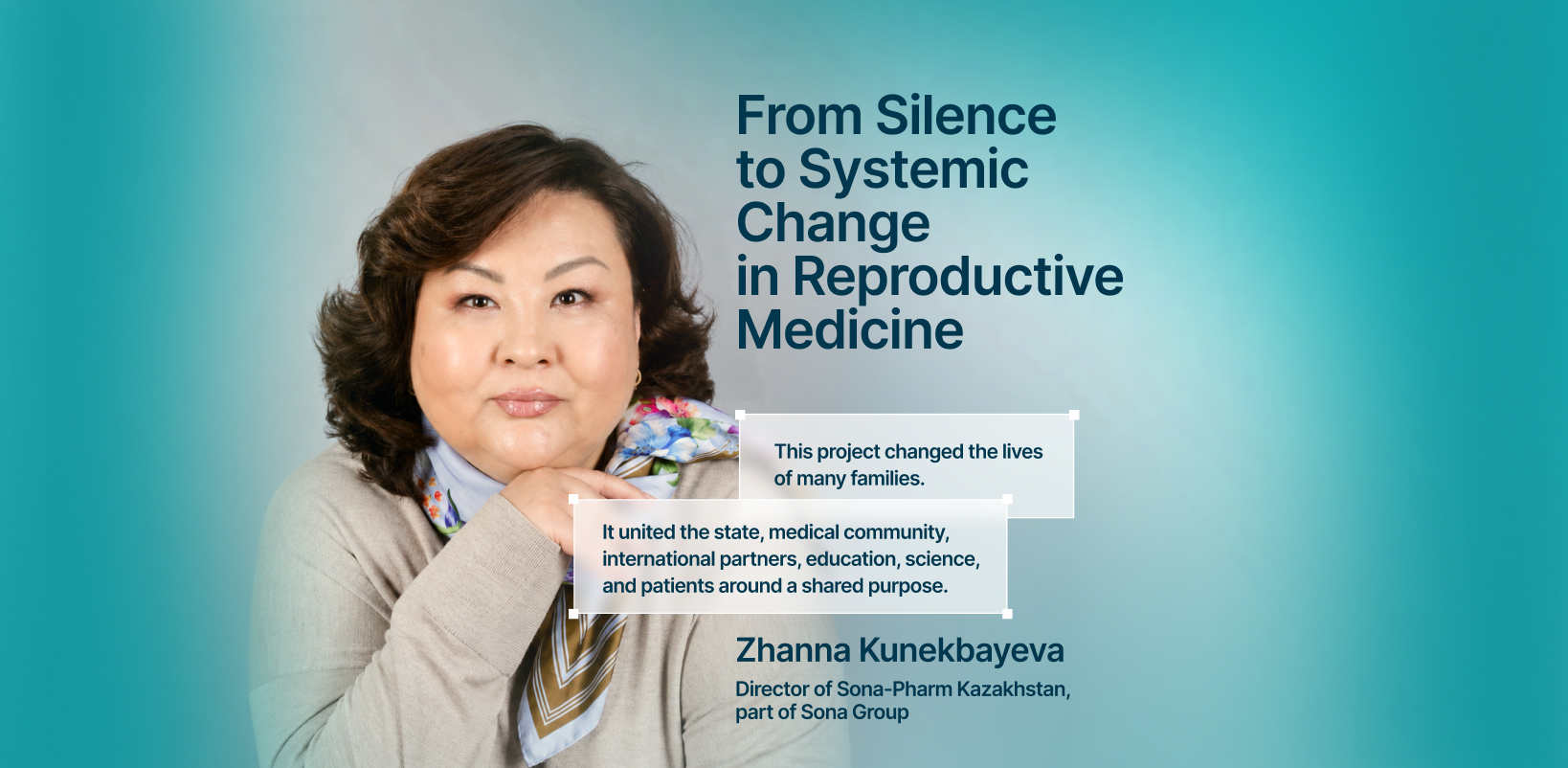
In this interview, Zhanna Kunekbayeva, General Director of Sona-Pharm Kazakhstan, part of Sona Group, reflects on the early stages of this initiative, the cultural and regulatory complexities surrounding ART in Uzbekistan, and why this project was never simply about business expansion.
At a time when modern assisted reproductive technologies were virtually unavailable to most families in Uzbekistan and the regulatory framework required to support their use had not yet been established, what did it mean for you to be part of a company helping support the early development of this field in the country? Did you view it primarily as a business opportunity, or as a broader institutional responsibility?
If I am completely honest, at that moment we were not thinking about markets, new business categories, or commercial opportunities. Those definitions sound far too corporate compared to what we were experiencing.
What we saw were real people and real families who had spent years living with pain, uncertainty, and a lack of options. For most families in Uzbekistan, access to modern assisted reproductive technologies was non-existent, while many approaches that had long become standard practice around the world remained unavailable.
We understood that this was about thousands of families who had spent years feeling they simply had no chance. About women who dreamed of becoming mothers, yet were left to face their fears, hopes, and pain largely on their own.
At that time, the necessary regulatory framework for the application of assisted reproductive technologies (ART) did not exist. Many aspects of ART required careful consideration from legal, ethical, and medical perspectives, while international best practices had to be adapted to the realities of the local healthcare system. In essence, the task was to build the foundation for the development of an entirely new field of medicine in the country. This is a natural path for any country that is only beginning to develop in this area.
This is precisely why the project never felt like “just business” to me. Of course, any system must ultimately be economically sustainable. But in this case, the foundation was responsibility, not commerce.
And I am deeply grateful that in Uzbekistan I met people who felt exactly the same way - doctors, healthcare leaders, experts, and members of our team who genuinely wanted not merely to “implement a project,” but to change the future of reproductive medicine in their country.
Without that level of commitment, none of this would have been possible.
What was the most difficult barrier in launching this initiative: regulatory, cultural, or medical? And what did you personally have to rethink along the way?
The hardest part was working with uncertainty and with the natural caution that surrounds any genuinely new field.
At that time, ART was viewed very carefully, not only by society, but sometimes even by parts of the medical community itself. We understood from the very beginning that this was not something that could be approached aggressively or rushed. Trust had to be built step by step.
One of the key priorities for all stakeholders was establishing an open and constructive dialogue with the Ministry of Health and the broader medical community. It was crucial that ART would not be perceived merely as a new technology or a commercial initiative, but as a long-term contribution to healthcare, demographics, and quality of life.
At the institutional level, there was a clear openness to studying international experience and exploring modern healthcare solutions. Uzbekistan was actively studying international experience, modern healthcare systems, and new approaches to medicine. What inspired me most was seeing a genuine focus on creating opportunities for patients to benefit from advances that had already become standard in many parts of the world.
I remember that period as a time of extraordinary energy: a country moving forward with confidence, while remaining deeply connected to its own traditions and cultural values. In Uzbekistan, family is far more than a social institution. It is one of the core values around which people build their lives, their connection between generations, their sense of home, support, and future. Children are not simply a continuation of the family line — they are the emotional center of the family itself.
That is why reproductive medicine in Uzbekistan has always carried a meaning far deeper than technology or medical innovation. And that, in many ways, became the true foundation of the project: not pressure or speed, but respect for the country, for its people, and for the process of change itself.
Then came enormous work with the medical community. We spent countless hours of discussing, explaining, listening, and searching for language that could be both scientifically rigorous and deeply human. Only after we felt genuine understanding and support from key healthcare stakeholders and the medical community did we begin moving further.
What became the decisive factor that brought different stakeholders together around this initiative?
I believe this collaboration became possible because all sides were genuinely sincere in their intentions and because each brought something the others could not provide alone.
Public healthcare institutions were exploring opportunities to modernize healthcare services and expand access to advanced medical approaches for patients. International healthcare partners contributed global expertise, evidence-based standards, and extensive experience in reproductive medicine.
Over time, this shared commitment was formalized through a Memorandum of Cooperation that brought together key stakeholders around a common vision for the future development of reproductive medicine in Uzbekistan. More importantly, the memorandum reflected a level of trust and alignment that had been built through years of dialogue and collaboration.
Our role as Sona-Pharm was to help bridge international expertise with local healthcare stakeholders — translating global standards into regional realities, building relationships, and ensuring that the dialogue remained grounded in the practical needs of patients and physicians in the region.
I am especially grateful to Ostap Kupnovitsky, Founder and Board Chairman of Sona Group, who was part of this initiative from the very beginning. We started this journey together, united by the belief that this was about far more than a business opportunity. Throughout the entire process, from the first discussions and meetings to the implementation of the project, his support, commitment, and belief in the importance of what we were trying to achieve never wavered. Looking back, I believe that shared conviction played an important role in turning this vision into reality.
But ultimately, everything came down to people.
I still remember many of the meetings in Tashkent, discussions with doctors, experts, and healthcare leaders. Some conversations were difficult. But what mattered most was the level of engagement and the shared desire to do something genuinely meaningful for the country.
That was when I truly appreciated how strong Uzbekistan’s professional medical community is, and how many people sincerely care about the future of healthcare in their country. For me personally, that gave enormous meaning to everything we were doing.
Reproductive technologies remain a sensitive topic in many countries. How do you build trust among both patients and physicians in such a cultural context?
In projects like this, trust is the most valuable asset.
It cannot be built through statements, presentations, or communications campaigns alone. People instinctively feel when they are being spoken to formally and when they are being approached honestly, respectfully, and with sensitivity toward their values, culture, and personal stories.
From the very beginning, we understood that communication around ART in Uzbekistan had to be exceptionally delicate and deeply respectful of the country’s cultural context.
For physicians, the priorities are evidence-based medicine, education, international quality standards, and access to dialogue with global experts. For patients, what matters most is safety, ethics, and the feeling that they are treated not as “clinical cases,” but as human beings with empathy and dignity.
That is why we deliberately chose not to focus on broad-reach promotion. Instead, we invested in medical education, expert platforms, international exchange of experience, and the gradual development of a professional community around ART.
Doctors themselves played an enormous role. They became the bridge of trust between technology and patients. We saw how carefully and responsibly the specialists we worked with approached this topic and how genuinely concerned they were about how society would perceive reproductive medicine.
This is how real trust is built, when people no longer see only technology, but real families finally receiving a chance to experience the happiness they had dreamed about for years.
Do you see this memorandum as the beginning of a broader movement toward the development of reproductive medicine across the region? What do you believe this ecosystem could look like in 5–10 years?
Absolutely.
From the beginning, we understood this was never only about several clinics or individual programs. It was about building an entire ecosystem: one that includes the state, the medical community, international partners, education, scientific infrastructure, and most importantly, patients who no longer have to face infertility alone.
Today, reproductive medicine in Uzbekistan is developing with real momentum. We already see stronger local expertise, more highly qualified specialists, modern medical centers, and emerging scientific programs.
But perhaps the most important transformation is societal. Infertility is gradually becoming less of a taboo, less of something people discuss only in whispers. And if this initiative contributed, even in a small way, to that positive shift, then all the efforts invested by everyone involved were worthwhile.
I believe that within the next 5–10 years, Central Asia will become a region where advanced medical technologies coexist with deeply rooted family values and a genuinely human-centered culture of care.
And it is precisely this combination: innovation, respect for tradition, and real care for people, that makes such projects truly sustainable and meaningful.
What do you personally consider the key measure of success for this initiative: the number of procedures, accessibility, or changing public attitudes toward ART?
For me, the most important indicator of success is not found in the numbers alone.
Yes, the number of procedures matters. Accessibility matters too. But real success begins when women and families stop feeling hopeless and realize they have a chance and that governments, doctors, international companies, and partners genuinely care about their stories.
If we speak systemically, success must be measured on several levels. On one level, it is about practical accessibility: trained specialists, modern medical centers, and the ability for families to receive treatment within their own country.
But the most difficult and the most important transformation is changing society’s relationship with reproductive health and ART itself.
Success is when people no longer feel fear or shame in seeking help. When physicians can discuss these topics professionally, openly, and without stigma. And when reproductive medicine becomes recognized as a normal and essential part of modern healthcare.
That is the kind of change that lasts.