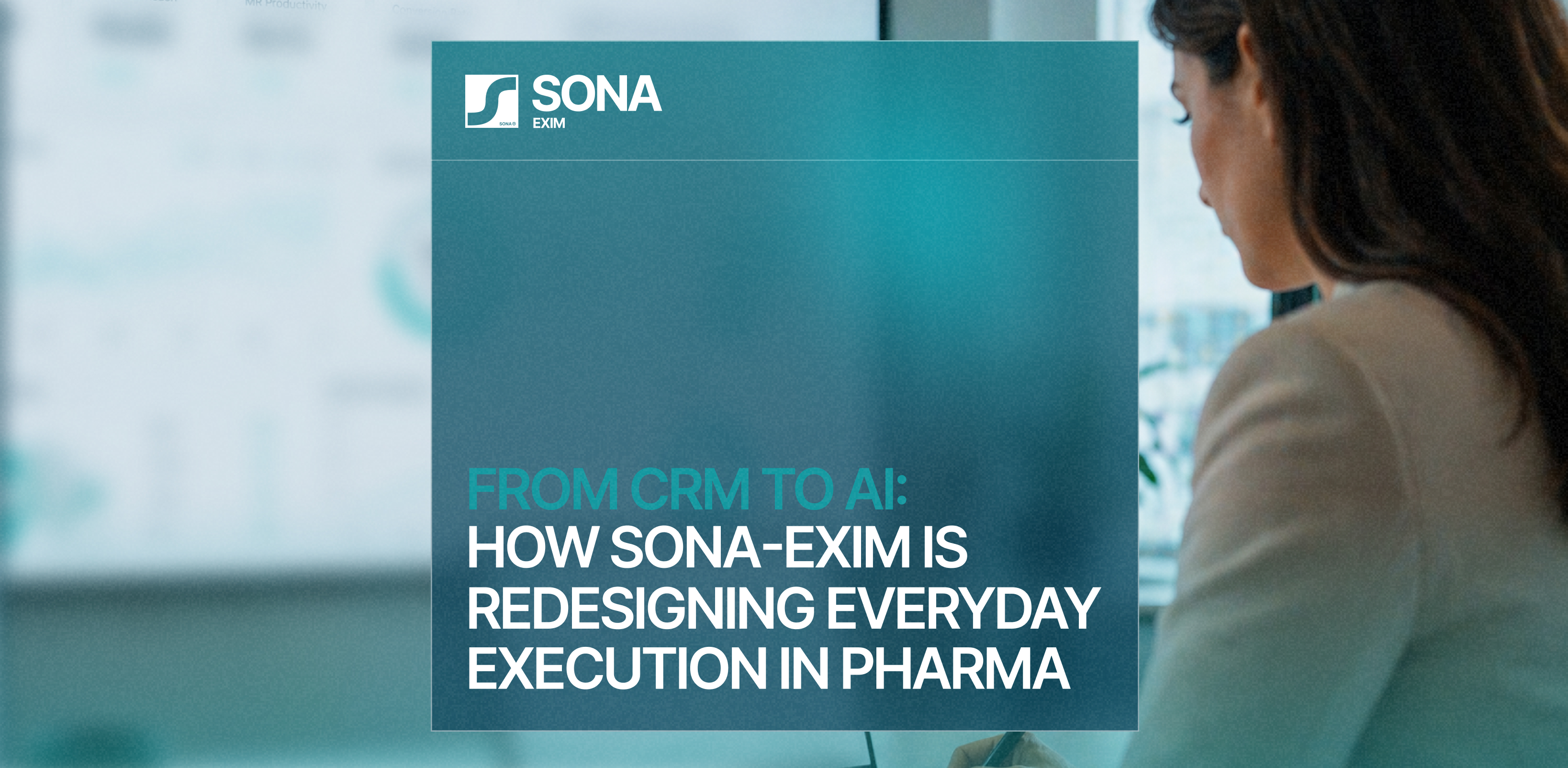
From CRM to AI: How Sona-Exim Is Redesigning Everyday Execution in Pharma
In pharma, artificial intelligence is moving beyond experimentation and into the core of daily operations. Zoriana Varchuk, Head of Marketing and Sales Force Excellence at Sona-Exim, explains how the company’s AI assistant is reshaping field-force efficiency, physician engagement, and the quality of commercial decision-making.
For years, digital transformation in pharma was largely associated with cleaner reporting, better dashboards, or more convenient data storage. That phase is over. Today, the real question is not whether a company has a CRM system, but whether that system helps people work faster, think more clearly, and make better decisions.
That was the business challenge Sona-Exim set out to solve. The company needed more than a standard CRM. It needed an operating environment built around centralized data management, analytics, and CLM capabilities — one that could improve the effectiveness of medical representatives, strengthen interaction with physicians, integrate with analytical databases across markets, and remain fully compliant with regulatory requirements in both Ukraine and Kazakhstan.
The resulting architecture combined several tools: Proxima Cloud CRM for managing the field force, Axioma as a syndicated database of physicians and medical institutions for precise targeting, GeoForce for territory management, Proxima PAS for strategic sales planning and resource allocation, and WHS and DWH for sales data processing. The integration of CRM, CLM, and Axioma then created the foundation for the next step: introducing an AI assistant.
The Real Role of AI
The most important point, Varchuk says, is that AI is not valuable because it is new. It is valuable because it removes friction.
Its role begins with routine work. Data entry, standard queries, and basic CRM support processes can be handled automatically, allowing the team to spend less time maintaining the system and more time on work that requires judgment and strategic focus.
The second layer is analytics. In this model, AI does not simply collect information. It identifies patterns, detects trends, and generates recommendations for action. In pharma, where the quality of commercial decisions increasingly depends on how quickly large data sets can be processed and translated into usable business logic, that matters a great deal.
The third layer is personalization. AI helps teams better understand the needs of those involved in the process and build more relevant scenarios inside the CRM. That has implications not only for service quality, but for the quality of engagement overall.
What Changed Most After Launch
Perhaps the biggest surprise was not automation itself, but its cumulative daily effect.
A digital assistant is always available. It does not pause, does not wait, and does not create queues. In practical terms, that changes the rhythm of work. Routine issues stop accumulating. Teams spend less time unblocking minor process delays and more time on the kind of tasks that require context, judgment, and strategic thinking.
A particularly important element of this setup is the Proxima AI chatbot, integrated directly into Proxima Cloud CRM. It provides instant support 24/7, answers routine questions, reduces delays, and allows the team to work continuously across time zones and languages. For the business, that is not just about speed. It is about using people’s time more intelligently.
Why Sales and Planning Stand to Gain the Most
One of the clearest areas where AI proves its value is sales management.
Because the system can process large volumes of information quickly, it helps teams analyze customer behavior, track conversion dynamics, and forecast future outcomes more accurately based on historical data. For pharma companies, this is no longer a nice-to-have feature. It is becoming a new planning standard. Predictive analytics built into CRM systems is gradually turning into an industry norm.
Technology Alone Does Not Deliver Transformation
Sona-Exim’s experience also makes one point clear: successful implementation cannot be explained by technology alone.
What matters is the combination — the quality of the system, the team’s willingness to work differently, close collaboration with the partner, and coordinated execution across everyone involved. That mix is what turns digital change from a one-time rollout into something that is genuinely embedded in business processes.
What Comes Next
In the near term, the role of the AI assistant will only expand.
Its impact goes well beyond operational optimization. It points to deeper changes: lower labor costs, higher productivity, stronger decision-making, and more personalized interaction across the process. In that sense, AI in CRM is no longer just another useful tool. It is becoming a new way of organizing work.
And that may be the most important conclusion of all. Digital transformation is no longer a question of technological fashion. It is a question of managerial maturity — and of whether a company is capable of building processes that are faster, sharper, and more scalable than before.